
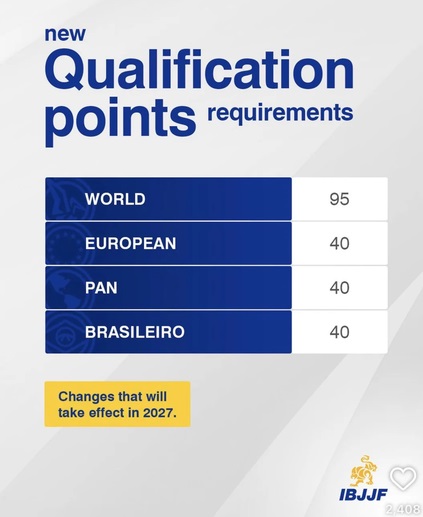
The International Brazilian Jiu-Jitsu Federation (IBJJF) has announced a significant overhaul of the ranking points athletes will need to accumulate in order to compete at the sport’s four biggest events. According to the federation, the changes will take effect in 2027, giving competitors roughly a year and a half to adjust their competition calendars.
The New Numbers
Under the updated system, black belt athletes will need the following point totals to register for each Grand Slam event:
- World Championship: 95 points
- European Championship: 40 points
- Pan Championship: 40 points
- Brasileiro (Brazilian Nationals): 40 points
What It Looked Like Before
Point-based qualification for IBJJF’s marquee events was first introduced back in 2018, when black belts needed 50 points to register for Worlds and 20 points for Europeans and Pans. Brasileiro, notably, has not historically carried its own points threshold, meaning athletes could enter Brazil’s national championship without first “earning their way in” through the ranking system the way they’ve had to for Worlds, Europeans, and Pans.
Athletes have long been able to earn these qualifying points by placing on the podium at IBJJF-sanctioned events such as national championships and international Opens, with points accumulating over a rolling multi-season window. Certain athletes, including former black belt World and No-Gi World Champions have always been exempt from the points requirement altogether, and that exemption appears to remain intact under the new structure.
What’s Changing, and Why It Matters
Comparing the two systems side by side, this is not a minor tweak:
| Event | Old Requirement | New Requirement (2027) | Change |
|---|---|---|---|
| Worlds | 50 pts | 95 pts | ~+90% |
| Europeans | 20 pts | 40 pts | +100% |
| Pans | 20 pts | 40 pts | +100% |
| Brasileiro | No requirement | 40 pts | New |
Two things stand out. First, the raw increase, nearly doubling the threshold for every event means athletes can no longer coast into a Grand Slam event on a single strong result or a couple of local Open medals. Second, and arguably more significant, is the addition of Brasileiro to the list of gated events. Brazil’s national championship has traditionally been one of the more accessible entry points into elite-level competition for black belts, given its size and depth. Bringing it in line with Europeans and Pans signals that the IBJJF now wants all four Grand Slam events treated as equally exclusive tiers, rather than having Brasileiro serve as an open on-ramp.
Big Change or Small Change?
This is a big change, not a small one. For up-and-coming black belts and part-time competitors — the “weekend warrior” demographic that makes up a large share of IBJJF’s competitor base nearly doubling the points requirement (while also closing the Brasileiro loophole) will likely mean:
- More competition volume required. Athletes will need to enter more qualifying Opens and mid-tier events, rather than banking on one or two results, to reach 40 or 95 points.
- Earlier season planning. Because points accumulate across a rolling multi-season window, athletes aiming for the 2027 majors will need to start stacking points well before the events themselves — likely throughout the 2026 season.
- A more top-heavy field. Raising the floor tends to shrink brackets at the biggest events, concentrating them further around athletes who compete frequently and successfully, while making it harder for late bloomers or newly promoted black belts to break in quickly.
- Ripple effects for academies and Opens. Local and regional Open tournaments, which serve as the primary points-earning venues below the Grand Slam tier, may see a bump in registration as athletes look for more chances to hit the new thresholds.
The exemptions for former World Champions remain, so the very top of the sport is largely insulated from this change. It’s the middle tier solid competitors working their way toward Grand Slam relevance who will feel the impact most.
What Athletes Should Do Now
With the change slated for 2027, competitors have time to adapt, but not an unlimited amount. Athletes targeting Worlds, Europeans, Pans, or Brasileiro that year should treat 2026 as a building block season: entering more Opens, being deliberate about weight-class consistency (since points don’t transfer between divisions), and tracking their running point totals well ahead of registration deadlines.
The IBJJF has not yet detailed whether any additional exemptions or transition provisions will apply during the shift to the new thresholds. Athletes and academies are advised to monitor official IBJJF channels for further clarification as 2027 approaches.

A freelance journalist with more than seven years of experience covering a wide range of topics, with a focus on delivering accurate, engaging, and well-researched reporting. He studied at the University of Birmingham, where he developed a strong foundation in journalism and communications. Martin is a 10th Planet BJJ brown belt and has been training for approximately 10 years and a keen follower of submission grappling.