Grappling produces new nicknames for old ideas all the time, but few have captured the imagination of the MMA and BJJ world quite like the Scottish Twister. It looks brutal, it’s rarely seen, and every time it shows up it becomes the highlight reel of the night. Here’s where it came from, how it evolved, and the fights that made it famous.
What Is the Scottish Twister?
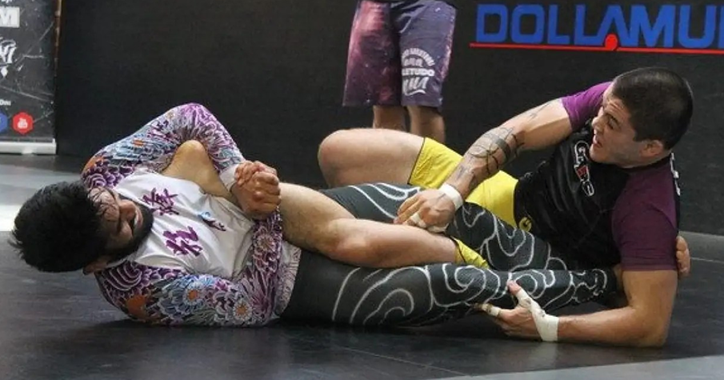
The Scottish Twister is a submission built on the same foundation as the standard Twister: the opponent’s lower body is pinned and controlled while their upper body is rotated in the opposite direction, generating extreme torque through the spine and rib cage. Fighters who have tapped to it describe the sensation as their ribs being pried apart rather than a clean, single-point crank.
What sets the Scottish Twister apart from the classic 10th Planet version is the entry and control mechanism. Rather than isolating just the far arm and head from a truck position, the Scottish Twister typically comes from a body triangle or hook control on the back, with the legs locking the opponent’s hips in place while the arms and shoulders wrap the head and torso for the twist. It’s particularly effective against taller, longer-limbed opponents, since the extra reach makes it easier to lock the necessary leg structure around a bigger frame.
Where the Twister Came From
To understand the Scottish Twister, you have to start with the Twister itself. Long before it had a name in jiu-jitsu, the core mechanic existed in amateur wrestling as the “wrestler’s guillotine,” a spine-torquing pin used to control opponents rather than finish fights.
Eddie Bravo encountered the position during his own wrestling background and later refined it while training under Jean-Jacques Machado. He renamed it the Twister to avoid confusion with the guillotine choke, and built it into the identity of his 10th Planet Jiu-Jitsu system, where it became a signature no-gi weapon built around the truck position.
The Twister stayed a curiosity in competitive grappling for years until Chan Sung Jung, better known as the Korean Zombie, used it to finish Leonard Garcia at UFC Fight Night in 2011. Jung later said he learned the technique from studying Bravo’s instructional videos, and the finish earned Submission of the Night. For a long stretch afterward, it stood as the only twister finish in UFC history and turned a niche 10th Planet move into something every grappling fan recognized on sight.
From Twister to Scottish Twister
The variation that became known as the Scottish Twister is credited to Scottish MMA veteran Stevie Ray. Nicknamed “Braveheart,” Ray built a reputation across his UFC and PFL career for finding unconventional finishes, and his modified version of the twister, wrapping the head and torso while trapping the hips with his legs, became his calling card.
Ray first pulled off the submission against former UFC lightweight champion Anthony Pettis at PFL 5 in 2022, a result that stunned fans given Pettis’s own grappling pedigree. The move earned its name from Ray’s nationality, and from that point forward, commentators and fans began referring to any twister variation of this style as a Scottish Twister regardless of who was applying it.
The finish became legend in September 2024, when Ray used it again in what was billed as his retirement fight, submitting Lewis Long in the first round at PFL Europe Glasgow, in front of his home crowd at the OVO Hydro. With his family cageside and just seconds left in the round, Ray’s signature move sent the arena into chaos and gave him one of the most poetic exits in modern MMA.
Notable Finishes With the Scottish Twister
Since Ray popularized it, the Scottish Twister has spread across multiple promotions, each finish adding to its reputation as one of the rarest and most feared submissions in the sport.
Stevie Ray vs. Anthony Pettis, PFL 5 (2022): The finish that started it all. Ray caught the former UFC champion in the modified twister for his first win over Pettis, giving the technique its name.
Stevie Ray vs. Lewis Long, PFL Europe Glasgow (2024): Ray’s second career use of the move, landed in his final professional fight in front of his home country, complete with a Performance bonus and a career-defining moment.
Jake Hadley vs. Matheus Mattos, PFL World Tournament (April 2025): Hadley worked from the back with hooks and a body triangle, transitioned through a rear-naked choke attempt, and finished with a third-round Scottish Twister in Orlando, one of the standout moments of the tournament.
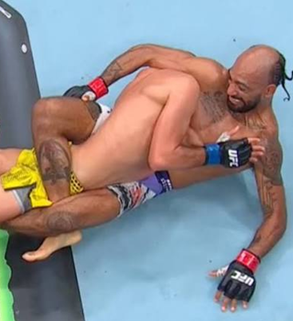
Murtazali Magomedov vs. Melsik Baghdasaryan, UFC Vegas 119 (2026): Making his UFC debut, Magomedov took Baghdasaryan’s back, secured a body triangle, and rolled into the Scottish Twister for a finish just over a minute into round one. It marked the first Scottish Twister finish in UFC history and put Magomedov alongside the Korean Zombie, Bryce Mitchell, and Da’Mon Blackshear as the only fighters to have won by twister in the promotion. He credited a training partner for showing him the setup shortly before fight week.
Additional finishes have come from fighters including Jack Grant, who landed the first Scottish Twister in OKTAGON history on his promotional debut and picked up a Performance of the Night bonus for it, and Gamid Khizriev in the PFL, adding to the small but growing list of fighters who have successfully hit the position under pressure.
Why It Stays Rare
Despite the attention each finish generates, the Scottish Twister remains one of the least common submissions in professional MMA and grappling. It demands a level of hip and leg control that’s difficult to establish against a resisting opponent, precise timing on when to initiate the twist, and often a size or reach advantage to lock the structure properly. Because the position also functions as a dominant back-control pin, fighters can hold it and land strikes even without completing the submission, which adds to its value inside the cage even when the tap doesn’t come.
For now, the technique remains closely tied to its Scottish origin story: a signature move built by one fighter, named after his homeland, and carried forward by a small but growing list of grapplers willing to attempt one of the sport’s most technical and punishing finishes.

A freelance journalist with more than seven years of experience covering a wide range of topics, with a focus on delivering accurate, engaging, and well-researched reporting. He studied at the University of Birmingham, where he developed a strong foundation in journalism and communications. Martin is a 10th Planet BJJ brown belt and has been training for approximately 10 years and a keen follower of submission grappling.