
Nine events into its existence, UFC BJJ has built a submission rate that no other major no-gi promotion is close to matching. Whether that gap holds up over time is still an open question, but the size of it, this early, is hard to ignore.
The Numbers
Across UFC BJJ 1 through UFC BJJ 9, 46 of 77 bouts have ended in a tap, which is a 59.7% finish rate.
Stack that against the competition:
- WNO (five 2025 cards, main + prelims): 27 submissions in 58 matches — 46.6%
- ADCC World Championship 2024: 53 submissions in 125 matches — 42.4%
- IBJJF No-Gi Worlds 2025 (adult black belt): 118 submissions in 257 matches — 45.9%
UFC BJJ is running roughly 13 points ahead of WNO, and 14–17 points ahead of ADCC and No-Gi Worlds.
None of these formats are apples-to-apples. UFC BJJ hand-picks its cards, ADCC and IBJJF force athletes through a bracket, and WNO runs a longer single-match format with its own matchmaking logic. Roster overlap and the current scramble for exclusive grappling contracts also shape who’s available to any given promotion, which muddies any clean comparison. Still, the gap is wide enough that it’s worth asking why.
Two Rules Changes Do Real Work Here
UFC BJJ’s format is three five-minute rounds, one-minute rests, no overtime. If nobody finishes, judges score using the 10-point-must system, but the scoring priority is submission attempts first, offense that’s actually building toward a finish second, and control a distant third.
That ordering punishes the classic “get top position, ride it out” game plan. A deep, escape-forcing submission attempt outweighs a takedown or a pass that goes nowhere. Guard-pulling without immediate action can draw cautions and point deductions, so even the patient, positional players (see Mason Fowler’s win over Pedro Machado at UFC BJJ 6) still have to keep creating action rather than parking in a safe position.
That’s one real driver of the submission rate. But it’s probably not the biggest one.
The Real Suspect: The Bowl
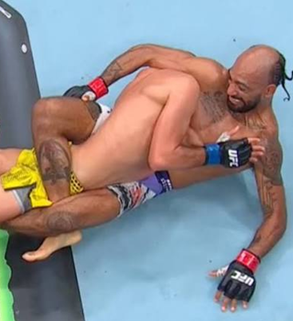
UFC BJJ competes on a curved, sloped surface “the Bowl” instead of a flat mat with a hard boundary line. And this is where the two most interesting explanations for the submission gap come in.
Theory one: athletes haven’t adjusted to it yet.
Every competitor on a UFC BJJ card learned their grappling on a flat mat with a clearly marked edge. Early results suggest a lot of competitors are still fighting the Bowl itself, not just their opponent, and getting caught mid-adjustment. If that’s true, the submission rate may cool off as athletes build real reps on a sloped surface and relearn how to defend near its edges.
Theory two: it’s not about adjustment at all
This might be the bigger factor. On a flat IBJJF mat, going out of bounds is a low-cost escape. Get stuck in a bad spot, scoot toward the line, and the worst case is usually a minor penalty or a stoppage and reset in the center, often before real damage is done. It’s a release valve, and elite competitors use it constantly.
The Bowl removes that valve almost entirely. There’s no flat edge to scramble toward, no cheap out-of-bounds reset waiting a few feet away. Once you’re in trouble, you’re in trouble on the slope, in the scramble, with the fight continuing. Exchanges that would get chopped up by a boundary stoppage on a flat mat just keep running in the Bowl instead.
You can see it in specific finishes. At UFC BJJ 9, Nick Rodriguez shot a fast double leg and rode top pressure straight to João Nicolite’s back, the kind of sequence that on a flat mat might get interrupted by a boundary reset. Achilles Rocha drove Filipe Pimentel up into the slope of the Bowl before finishing a heel hook. Neither is proof by itself, but both are consistent with a surface that keeps grappling live instead of giving athletes a bail-out.
If this theory holds, it’s a structural effect, not a temporary adjustment problem, meaning the higher finish rate might be a permanent feature of Bowl grappling rather than something that regresses once athletes get more mat time on it.
The Rate Isn’t Stable Yet
Worth flagging before anyone declares the Bowl a finishing machine: the submission numbers have been anything but smooth.
UFC BJJ 1 opened hot, seven submissions in eight bouts. UFC BJJ 6 cratered to one submission in eight bouts, plus a draw. The last three events swung back up to 19 submissions in 25 bouts..
That kind of swing is normal for small samples. Matchmaking, weight classes, late replacements, and unfamiliar-opponent pairings all move the number around independently of the rules or the mat. A promotion also has an obvious incentive to book athletes who are likely to go for finishes, since that’s the product it’s selling. WNO faces the same incentive, filtered through a different format.
The Bottom Line
Nine events isn’t a large enough sample to call this settled. But the direction of the evidence points at two structural features of UFC BJJ specifically the submission-first scoring order, and a Bowl that removes the out-of-bounds escape valve IBJJF and other flat-mat formats provide, rather than pure randomness or roster selection. The adjustment-period theory and the no-way-out theory aren’t mutually exclusive, either. Both could be true at once, with the adjustment effect fading over the next few years while the structural effect of the Bowl remains.

A freelance journalist with more than seven years of experience covering a wide range of topics, with a focus on delivering accurate, engaging, and well-researched reporting. He studied at the University of Birmingham, where he developed a strong foundation in journalism and communications. Martin is a 10th Planet BJJ brown belt and has been training for approximately 10 years and a keen follower of submission grappling.