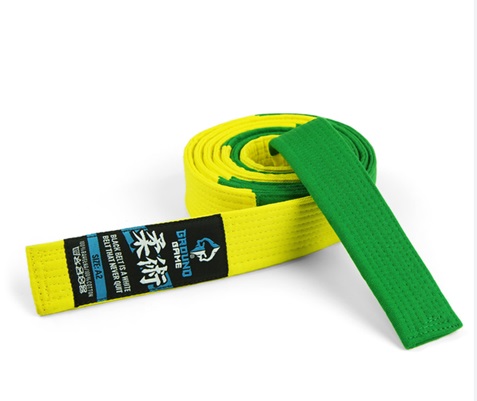
In Brazilian Jiu Jitsu competitions, you may occasionally see one competitor wearing a green and yellow striped belt over their regular rank belt. At first glance, this can look confusing—especially since it doesn’t represent rank. However, this belt has a very specific purpose in competition settings.
What is the green and yellow belt?
The green and yellow striped belt is not a rank belt in Brazilian Jiu Jitsu. Instead, it is a competition tool used to help referees distinguish between athletes during matches.
In IBJJF-style events, when two competitors are stepping onto the mats, one athlete may be required to wear this additional belt over their normal belt. This is especially common when:
- Both athletes are wearing similar colored gis
- It is difficult for referees to clearly distinguish competitors during action
- A clearer scoring reference is needed for officials
The belt does not indicate skill level, experience, or rank—it is purely functional.
Why is it used in competition?
Because Brazilian Jiu Jitsu matches can become fast-paced and complex, referees must track points accurately in real time. However, problems can arise when:
- Gis are similar in color (for example, both white or both blue)
- Athletes are tangled or partially obscured during scrambles
- The referee’s view is blocked during transitions
To solve this, one athlete is assigned the green/yellow striped belt, and the referee aligns scoring responsibility accordingly.
In some cases, the referee may also use matching wristbands to further simplify scoring identification.
How does it work for scoring?
The system essentially assigns one athlete as the “designated reference” for scoring.
- The athlete wearing the green/yellow belt is linked to a specific scoring side or identifier
- The referee uses this assignment to ensure points are recorded correctly
- This reduces confusion when both athletes are in similar positions or wearing similar gear
In no-gi competitions, a similar system is used, but instead of belts, athletes may wear colored ankle bands for identification.
Is it used in all matches?
No. The green/yellow belt is typically only used when necessary. If competitors are easy to distinguish—such as wearing clearly different colored gis—it may not be required at all.
Its use is often at the referee’s discretion or based on tournament rules.
Does it give any advantage or disadvantage?
There is no official competitive advantage built into the system. However, some people wonder whether it could be slightly inconvenient.
Potential concerns include:
- Having to wear an additional belt over your own rank belt
- Possible discomfort or slight restriction if tied poorly
- Minor distraction before the match starts
In practice, most competitors adapt quickly, and it has no meaningful effect on performance.
It is important to note that the belt is not tied to ranking, prestige, or competition seeding—it is purely an identification tool.
Final thoughts
The green and yellow striped belt is a simple but practical solution used in BJJ competitions to help referees track scoring accurately. While it may look unusual to spectators or newer practitioners, it has no bearing on rank or skill level.
Ultimately, it exists for one reason only: to reduce confusion and make refereeing more reliable during matches.