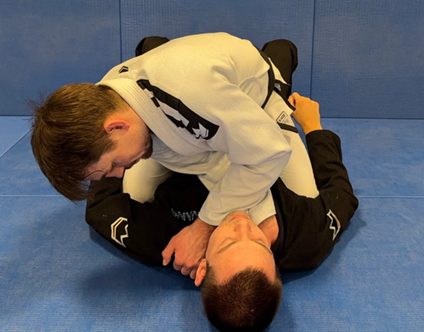
One of the first things new Brazilian Jiu-Jitsu practitioners notice is that there seems to be an endless number of chokes. Every few weeks, someone at the academy demonstrates another variation that you’ve never seen before.
So, how many chokes are there in BJJ?
The short answer is that nobody knows the exact number.
Unlike techniques with fixed rules or standardized names, Brazilian Jiu-Jitsu is constantly evolving. New grips, setups, lapel configurations, and transitions regularly give rise to new choke variations. While most practitioners rely on roughly 20 to 30 core chokes, there are well over 100 named variations used throughout the grappling world.
Why It’s Impossible to Count Every Choke
Brazilian Jiu-Jitsu isn’t governed by a single technical encyclopedia.
Different instructors often teach the same choke under different names, while minor grip changes are sometimes considered entirely new techniques.
For example, a rear naked choke can be finished using:
- The traditional palm-to-biceps grip
- A short choke variation
- A one-arm finish
- Different body triangle configurations
Are these separate chokes or simply variations of the same submission?
There is no universal answer.
The same applies to countless gi chokes, where changing a sleeve grip, lapel feed, or angle of attack can create what many academies consider a completely different technique.
The Main Categories of BJJ Chokes
Rather than trying to memorize every individual submission, it’s more useful to understand the major categories.
1. Rear Chokes
These attacks come from back control and include techniques such as:
- Rear Naked Choke
- Short Choke
- Bow and Arrow Choke
- Sliding Collar Choke
Many instructors consider back attacks the highest-percentage submissions in all of Jiu-Jitsu because they combine excellent positional control with limited defensive options.
2. Collar Chokes
The gi opens the door to an enormous number of submissions.
Popular examples include:
- Cross Collar Choke
- Baseball Bat Choke
- Clock Choke
- Loop Choke
- Paper Cutter Choke
- Ezekiel Choke
- Brabo Choke
- Bow and Arrow Choke
Because lapels and sleeves can be fed in countless ways, this category probably contains more variations than any other.
3. Arm Chokes
Instead of using the gi, these submissions rely on positioning an opponent’s shoulder against one side of the neck while your arm compresses the other.
Examples include:
- Arm Triangle
- D’Arce Choke
- Anaconda Choke
- Japanese Necktie
- Peruvian Necktie
- Von Flue Choke
Although each uses different mechanics, they all rely on controlling the head and one arm.
4. Front Headlock Chokes
Whenever you control your opponent’s head from the front, several submissions become available.
These include:
- Guillotine Choke
- High-Elbow Guillotine
- Arm-In Guillotine
- Marcelotine
- Ninja Choke
Modern no-gi competition has greatly expanded this family of attacks.
5. Leg Chokes
Some of the most creative submissions in BJJ use the legs rather than the arms.
Examples include:
- Triangle Choke
- Reverse Triangle
- Inverted Triangle
- Flying Triangle
- Gogoplata
Although less common than arm-based submissions, these techniques remain among the most iconic finishes in grappling.
Blood Chokes vs. Air Chokes
Not all chokes work the same way.
Most successful BJJ submissions are technically strangles, meaning they compress the carotid arteries and temporarily reduce blood flow to the brain. These submissions often cause unconsciousness within seconds if an opponent refuses to tap.
Examples include:
- Rear Naked Choke
- Triangle Choke
- Arm Triangle
- D’Arce Choke
Other techniques compress the trachea instead.
These are commonly called air chokes and tend to be more painful than blood chokes.
Examples include:
- Ezekiel Choke
- Punch Choke
- Certain Guillotine variations
Many submissions actually combine both mechanisms depending on how they’re applied.
The Most Common Chokes Every BJJ Student Should Learn
While there may be over a hundred named variations, beginners only need to master a handful before expanding their arsenal.
A solid foundation includes:
- Rear Naked Choke
- Cross Collar Choke
- Guillotine
- Triangle Choke
- Arm Triangle
- D’Arce Choke
- Bow and Arrow Choke
- Baseball Bat Choke
- Ezekiel Choke
- North-South Choke
These submissions appear consistently in competition and represent many of the major mechanical principles behind choking techniques.
Which Choke Is the Most Effective?
If competition results are any indication, the Rear Naked Choke remains the king of submissions.
Across both MMA and high-level grappling, it consistently produces more finishes than any other choke. This is largely because back control is one of the most dominant positions in combat sports, giving the attacker exceptional control while limiting the defender’s escape options.
That doesn’t mean other chokes are less valuable.
Elite competitors often build entire games around guillotines, arm triangles, collar chokes, or leg-based attacks depending on their preferred positions and ruleset.
Will New Chokes Continue to Be Invented?
Almost certainly.
Modern competitors are constantly experimenting with new lapel feeds, front headlock systems, and hybrid attacks that blur the line between existing submissions.
What begins as a slight variation in grip or angle often evolves into a named technique taught at academies around the world.
This continual innovation is one of the reasons Brazilian Jiu-Jitsu remains one of the fastest-evolving martial arts.
Final Thoughts
Trying to count every choke in Brazilian Jiu-Jitsu is a bit like trying to count every guard variation—new ones appear faster than anyone can catalog them.
Instead of focusing on the total number, concentrate on understanding the core mechanics behind each family of submissions. Once you understand how blood chokes, air chokes, collar attacks, arm chokes, and leg-based submissions work, learning new variations becomes much easier.
Whether your goal is competition or self-defense, mastering a small number of high-percentage chokes will take you much further than trying to memorize every submission ever named.