Few athletes transition as naturally into Brazilian Jiu-Jitsu as former rugby professionals. The physicality, clinch work, and contact-heavy instincts from rugby often translate surprisingly well onto the mats. One of the most interesting examples of this crossover is former All Blacks captain Tana Umaga, whose post-rugby journey into BJJ has been marked by steady progress, competition success, and a genuine commitment to the art.
From elite rugby to the grappling mats
Tana Umaga is best known as one of New Zealand rugby’s most respected figures—an All Blacks captain and one of the most influential backs of his era. After retiring from professional rugby, he eventually found his way into Brazilian Jiu-Jitsu, beginning a new athletic chapter that would span more than a decade.
What started as curiosity and cross-training quickly became a long-term pursuit. Over the years, Umaga trained consistently, building skills in positional control, submissions, and live grappling against experienced practitioners in New Zealand’s competitive BJJ scene.
His rugby background—especially dealing with tackles, scrums, and constant physical pressure—gave him a natural base for grappling exchanges, even if BJJ required a completely new technical framework.
A long road through the belts
Umaga’s progression in BJJ was not rushed. Like most dedicated practitioners, he spent years working through the ranks while balancing coaching and life after professional sport.
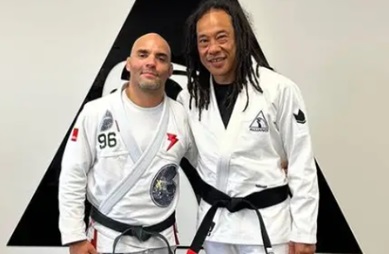
He eventually reached brown belt level after years of training and competition, regularly testing himself at higher-level events rather than treating BJJ as casual cross-training. His approach reflected a genuine athlete’s mindset: measurable progress through competition rather than symbolic participation.
That journey culminated in one of his standout competitive achievements.
Silver at the IBJJF Masters World Championship
One of the most notable highlights of Umaga’s BJJ career came at the IBJJF Masters World Championship, where he earned a silver medal at brown belt level.
The Masters divisions are known for experienced, physically strong competitors—many of whom have trained for decades. Medalling at that level requires not just athleticism, but timing, strategy, and composure under pressure.
Umaga’s performance stood out not because of novelty, but because it demonstrated that his development in BJJ was real, sustained, and competitive on an international stage.
For many observers, it reinforced a familiar pattern: elite athletes from contact sports often adapt quickly to grappling, but success at IBJJF level still demands technical depth built over years.